Travellers' Choice™ Best of the Best


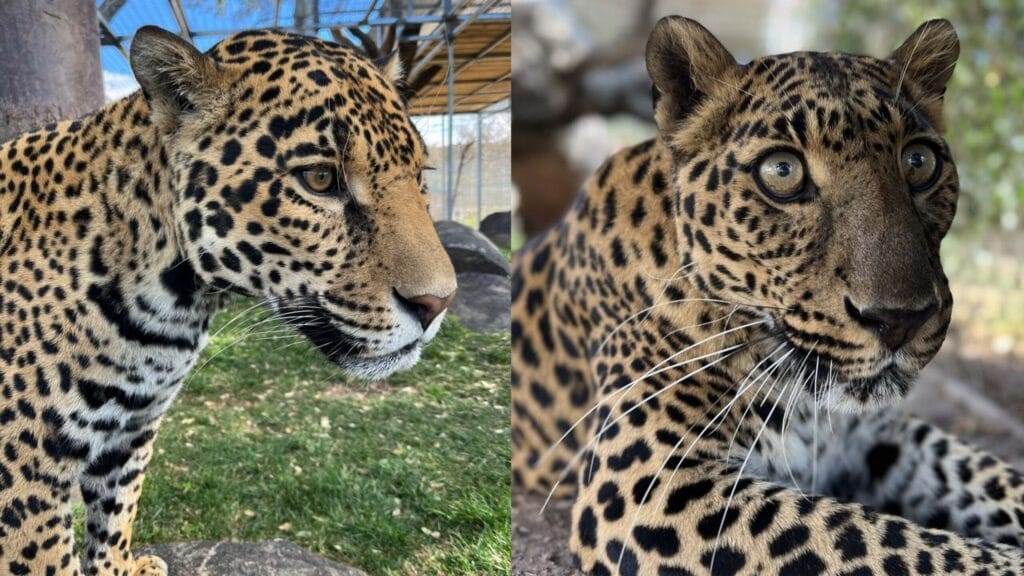
In the world of wild cats, few animals are as easily confused as the jaguar and the leopard. To the untrained eye, they look remarkably similar: both are stunning, golden-coated apex predators covered in black spots, and both exude an aura of raw power.
It is a common question we hear at Lions Tigers & Bears. Visitors often point to a large spotted cat and ask, "Is that a leopard or a jaguar?" or sometimes they’ll refer to them simply as a "panther cat."
While they do share a family tree, jaguars and leopards are distinct species living oceans apart. They have evolved different bodies, behaviors, and animal markings to rule their respective jungles. Understanding how to identify big cats isn't just a fun party trick; it helps us appreciate the incredible biodiversity of our planet and understand why these animals have such specialized needs — needs that can never be met in a private home.
So, how do you tell them apart? Let’s spot the differences.

The quickest way to distinguish a jaguar from a leopard is to look closely at their spots. Both cats feature rosette patterns (rose-like markings on their fur) but the design is different.
If you see a large rosette with a speck of black in the center, you are almost certainly looking at a jaguar. This subtle difference in animal markings provides excellent camouflage in the dappled light of the South American rainforests for jaguars, versus the savannas and forests of Africa and Asia for leopards.
While both are formidable apex predators, their body shapes reveal their different hunting styles.

Their lifestyles in the wild are perhaps the most distinct difference.
Jaguars are water-loving cats. Unlike most felines who despise getting wet, jaguars are excellent swimmers. They live in the wet rainforests and wetlands (like the Pantanal in Brazil), where they happily dive into rivers to hunt caimans, fish, or turtles. Their incredible bite force (the strongest of all big cats relative to size) allows them to pierce the shells of turtles and the thick hides of crocodilians.
Leopards, on the other hand, are the masters of the trees. Thanks to their powerful claws, leopards are famous for hauling heavy prey (sometimes heavier than themselves) high up into tree branches to keep it safe from scavengers like hyenas and lions. While jaguars can climb, they aren't as graceful or frequent climbers as leopards.
One simple way to tell them apart is to look at a map. These cats in the wild do not share the same zip code.
You might be wondering, "Where does the black panther fit in?"
The term "black panther" doesn't refer to a separate species. It is a catch-all term for any melanistic (black-coated) big cat. A black panther in Asia or Africa is a melanistic leopard. A black panther in the Americas is a melanistic jaguar.
Even with their dark coats, if you look closely under sunlight, you can still see the faint outline of their rosette patterns, the "ghost rosettes" hidden in the fur.
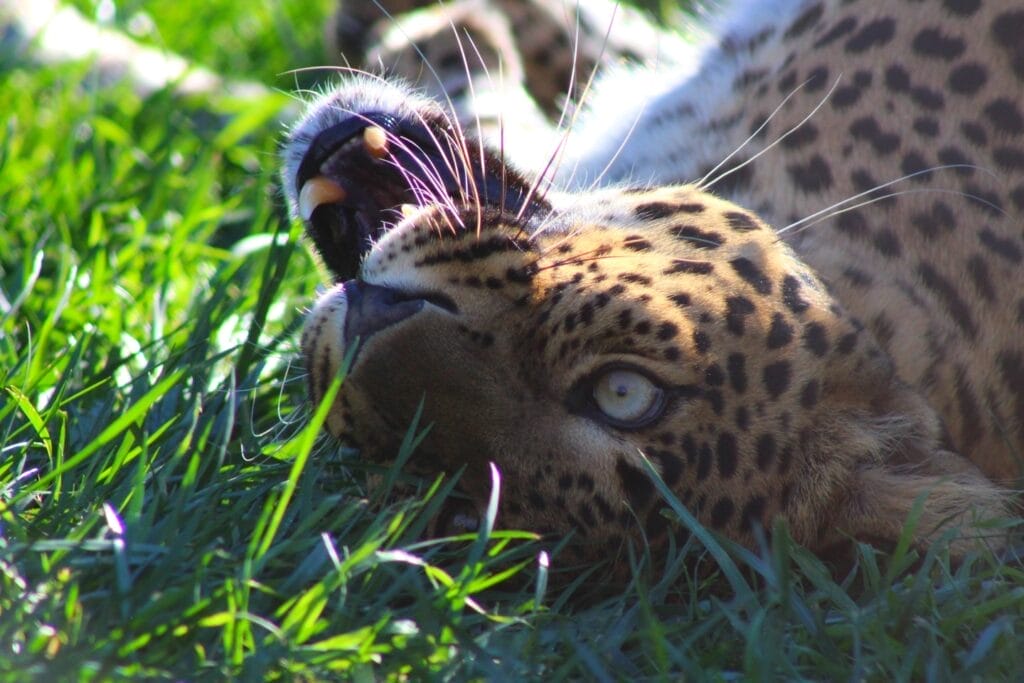
Despite their beauty, the demand to own these animals drives a cruel underground trade. People see a cub and think it looks like a house cat, failing to realize that these are wild animals that cannot be domesticated.



Domestication takes thousands of years of selective breeding. Taming a wild animal is simply suppressing its instincts through fear or training, but those instincts never disappear.
A jaguar’s bite force is strong enough to easily crush a human skull. A leopard’s predatory drive is wired for hunting. When people attempt to keep them as pets, the animals suffer. They are often kept in small cages, fed improper diets leading to metabolic bone disease, and declawed (a painful amputation of their toes) to make them "safe."
This is why big cat rescue organizations like Lions Tigers & Bears exist. We provide sanctuary for animals that were bought as status symbols and then discarded when they became too big, too expensive, or too dangerous to handle.
Jaguars and leopards are icons of the wild. They are critical to the health of their ecosystems, keeping prey populations in check. The best way to love these animals is to protect their habitats and refuse to support industries that exploit them, such as cub petting or private ownership.
By learning how to identify big cats and understanding their true nature, you can become a better advocate for their protection.
1. Who would win in a fight, a jaguar or a leopard?
While we never want to see animals fight, a jaguar would have the advantage due to sheer mass and bite force. Jaguars are heavier, more muscular, and have a significantly stronger bite than leopards. However, a leopard would likely be faster and more agile, allowing it to escape into the trees.
2. Can jaguars and leopards mate?
In the wild, they never meet because they live on different continents. In captivity, unethical breeders have sometimes crossbred them (creating hybrids like "jagupards"), but this practice is frowned upon by reputable conservationists. It serves no conservation purpose and often results in animals with severe health issues. Accredited sanctuaries strictly forbid breeding.
3. Are there wild jaguars in the United States?
Historically, yes. Jaguars once roamed the American Southwest. Today, solitary male jaguars are occasionally spotted in southern Arizona, and New Mexico, crossing the border from Mexico, but there is no known breeding population currently in the U.S.
4. Why do people call them "Panthers"?
The scientific genus for big cats (lions, tigers, jaguars, leopards) is Panthera. The term "Panther" is often used colloquially to describe black leopards or black jaguars, or sometimes even Florida cougars (though cougars are in the genus Puma, not Panthera).
Want to learn more about big cats? Visit Lions Tigers & Bears to see our rescued residents up close and learn about the global efforts to end the trade in exotic animals. Your visit supports big cat rescue and lifelong care for animals in need. Plan your visit today!




Ph: 619.659.8078
Fx: 619.659.8841
[email protected]
24402 Martin Way, Alpine, CA 91901
Subscribe for our newsletter & get the latest news, exclusive deals, and to hear amazing stories of our rescued animals!