Travellers' Choice™ Best of the Best



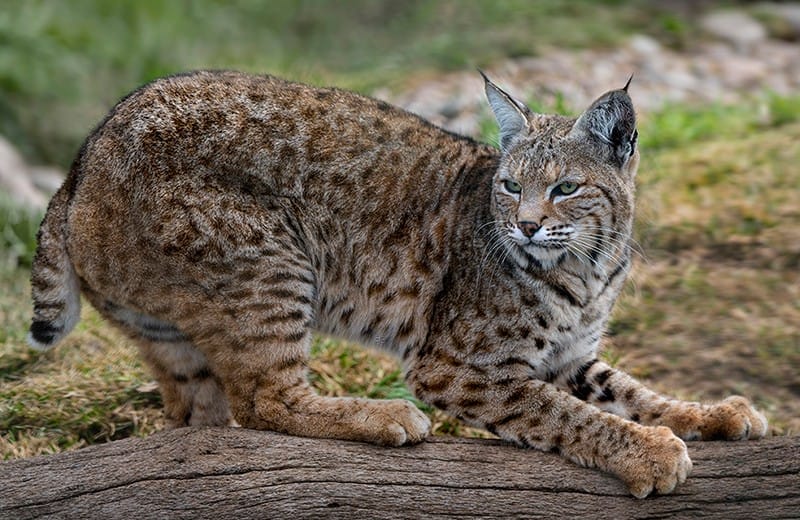
If you’ve ever watched a tiger prowl through the tall grass or a leopard lounge on a high branch at Lions Tigers & Bears, you’ve probably noticed one of their most expressive features: the tail. From the massive, muscular tail of a mountain lion to the short, stubby "bob" of a bobcat, these features are far more than just decorative. In the animal kingdom, a tail is a high-tech "power tool" that’s essential for their survival.
But have you ever wondered why some animals have long, swishy tails while others have almost none at all? Or maybe you’ve wondered why you don’t have a tail? Let’s take a look at the "tail tales" of the animal world!
For big cats that climb, the tail acts as a vital counterweight. Balance is a cat's superpower, and their tails help make it possible. Consider the leopard, one of the most agile climbers at our San Diego animal sanctuary. When a leopard carries heavy prey up into a tree to hide it from scavengers, its long, heavy tail shifts in the opposite direction of its body to prevent it from tipping over — much like a tightrope walker’s long pole.
Even on the ground, the cheetah uses its tail like a boat’s rudder. During high-speed chases, the cheetah can make sharp, 90-degree turns because its tail swings to the opposite side, helping it maintain traction and correct its center of gravity at 60 mph.
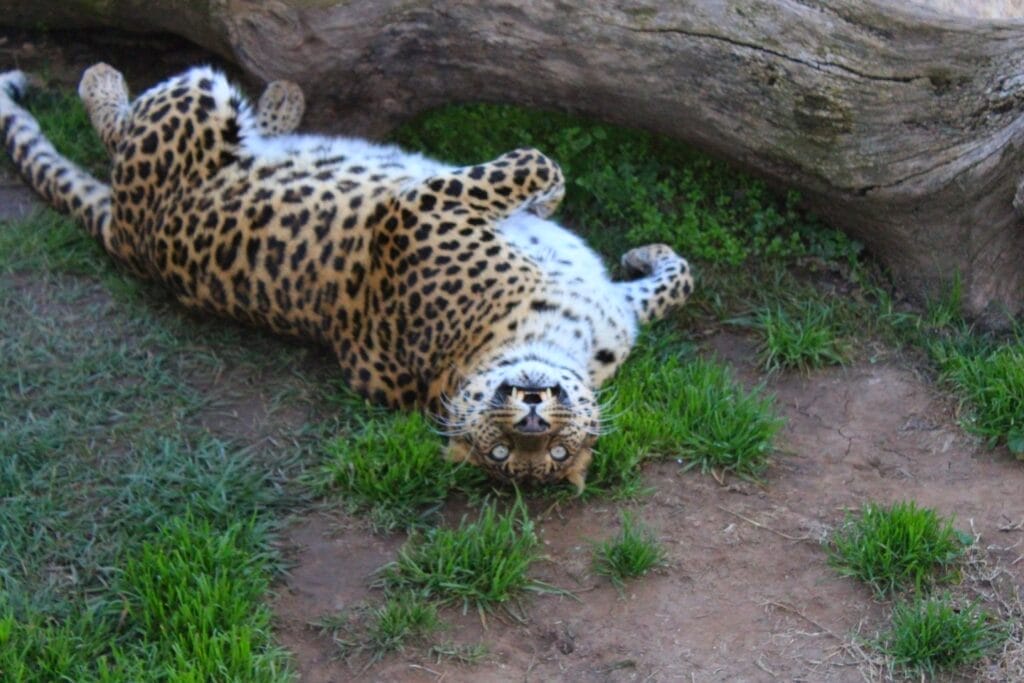
Tails are the ultimate silent communicators. While a lion’s roar can be heard up to five miles away, its tail often tells a more subtle story.
Habitat and lifestyle play a major role in how a tail evolves.
While tails are pretty common in the Animal Kingdom, and most mammals have tails, there are a few notable exceptions. Capybaras, guinea pigs, and frogs are all tailless, but the most famous group of tailless mammals is the hominoids: apes and humans.
So, what happened to our tails? Scientists recently discovered that around 25 million years ago, a "jumping gene" called an Alu element hopped into a gene responsible for tail development in our ancestors. This caused the tail to vanish almost "overnight" in evolutionary terms.
But why did this change stick? As our evolutionary ancestors began moving through trees by hanging from branches (brachiation) and eventually walking on two legs, a long tail became more of a hindrance than a help. While it seems like we lost our tails, we actually still have a tiny reminder: the coccyx, or tailbone, at the base of your spine.

Q: Do animals feel pain in their tails?
A: Yes. An animal’s tail is an extension of its spine, containing vertebrae, muscles, and sensitive nerves. This is why any injury to a tail can be very serious and requires expert veterinary care.
Q: Why do some cats, like the Manx, have no tails?
A: Taillessness in domestic cat breeds like the Manx is usually due to a random genetic mutation. While they look cute, this mutation can sometimes cause spinal problems, which is why we advocate for ethical breeding and animal welfare.
Q: Can an animal survive without its tail?
A: Many animals can adapt to the loss of a tail due to injury, but it often makes their life harder. It can impair their balance, make them less efficient hunters, and disrupt their ability to communicate with their own species.
Q: Do all big cats have long tails?
A: Most do, but the Bobcat and Lynx are famous for their short, "bobbed" tails. These cats hunt primarily on the ground in rocky or brushy terrain where a long tail might actually get snagged on bushes!
The next time you visit Lions Tigers & Bears, pay close attention to the residents' tails! See if you can spot the difference between the thick, powerful tail of Jillian the Lion and the shorter, shaggy tail of Liberty the Bear. Understanding these "tail tales" helps us appreciate the incredible ways animals have adapted to survive in the wild, and why they deserve our protection here at the sanctuary.




Ph: 619.659.8078
Fx: 619.659.8841
[email protected]
24402 Martin Way, Alpine, CA 91901
Subscribe for our newsletter & get the latest news, exclusive deals, and to hear amazing stories of our rescued animals!